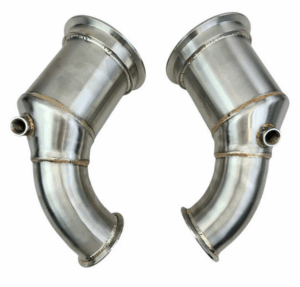
What is an Exhaust Downpipe? What does a Downpipe do?
DOWNPIPES – COMPLETE TECHNICAL OVERVIEW FOR MODERN TURBOCHARGED VEHICLES A downpipe is the essential link
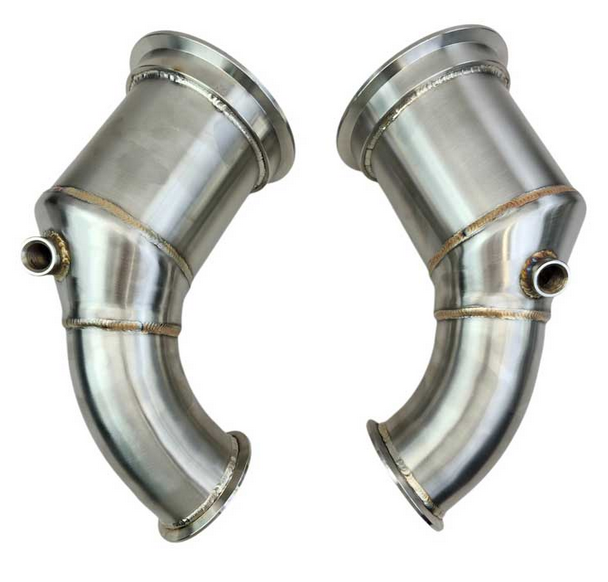
A downpipe is the essential link between the turbocharger and the rest of your exhaust system. On most turbocharged European performance cars—whether that’s the Audi S4, Mercedes-AMG A45 S, BMW M340i, Porsche Macan S, or VW Golf R—the downpipe is responsible for guiding hot, high-velocity exhaust gases away from the turbine housing as efficiently as possible.
In factory form, downpipes are designed to meet noise restrictions, emissions regulations, and packaging demands. As a result, they’re often more restrictive than enthusiasts want—especially on engines with tuning potential far beyond stock output. Aftermarket downpipes solve this problem by increasing flow, reducing back pressure, and providing the turbocharger with a far less restrictive path to expel exhaust gases.
When the turbocharger compresses intake air, it needs an equally efficient system for removing exhaust gases. Those gases spin the turbine wheel, which in turn drives the compressor wheel. The faster the exhaust can leave the turbo, the faster the turbine can accelerate—and the quicker the boost comes on.
On vehicles like the Audi RS3 (2.5 TFSI) or BMW M2 (S58), the turbocharger setup relies heavily on downward exhaust flow immediately after the turbine. The downpipe directs these gases straight into the mid-section of the exhaust system. Any restriction in this first section drastically affects turbo efficiency, response, and temperature.
The bigger the turbo and the more boost it produces—think Mercedes-AMG C63, Audi RS6, or Porsche Cayenne Turbo—the more critical a high-flow downpipe becomes.
Although designs vary, most performance downpipes share core components:
The downpipe bolts directly to the turbocharger’s turbine housing.
Modern ECUs rely on multiple O₂ sensors for fuel trims, catalyst efficiency checks, and boost calculations.
Aftermarket downpipes include threaded bungs to maintain OEM sensor placement.
A small but essential component, the flex section absorbs:
OEM systems—especially on EU vehicles—often include multiple catalytic converters.
Aftermarket downpipes replace these with:
Most downpipes are made from 304 stainless steel, which resists corrosion and can handle extreme exhaust temperatures.
Some premium systems—like those for Audi RS or Porsche models—may use 321 stainless or specially coated steels for even higher durability.
Larger pipe diameter = lower back pressure = faster turbo response.
But diameter must match turbo size, engine output, and tuning goals.
For example:
Upgrading a downpipe provides one of the biggest improvements per dollar for any turbocharged vehicle.
Factory systems choke the turbo at high RPM.
A performance downpipe dramatically lowers this resistance.
Upgraded downpipes help the turbo reach target boost quicker.
This is especially noticeable on models like the Audi S3, BMW 435i, and Mercedes-AMG CLA45.
More efficient gas flow → cooler EGTs (exhaust gas temps) → more stable boost → safer power.
Gains vary by engine:
Lower back pressure = less heat and mechanical stress on the turbine wheel.
The exhaust note becomes:
With improved efficiency, cruising consumption can drop slightly.
You’ll typically choose between:
Includes a performance catalytic converter.
Pros:
No catalytic converter.
Pros:
Cons:
Different engineering approaches impact how gases merge and flow.
Low-cost, simple, but turbulent near the turbo outlet.
A wide, smooth transition from turbo to main pipe.
Separates wastegate gases, then merges them smoothly.
Keeps gases completely separate until farther down.
Pros: smoother turbo gas flow
Cons: complex, expensive, and can crack under heat—seen on heavily tuned BMW N55/N54 builds.
Durable, heat-retaining, perfect for ultra-high-temp engines like AMG V8 biturbo models.
Lightweight and efficient when properly manufactured.
When upgrading a downpipe, ECU tuning is critical.
Modern engine control systems expect certain exhaust flow and catalyst readings. When you install a freer-flowing downpipe:
Without proper recalibration, this can trigger warning lights or lead to unsafe conditions.
A matching ECU tune ensures maximum performance, smooth drivability, and proper control of the wastegate and turbo systems.
Stock downpipes are often high-quality but tuned for emissions, not performance. For example:
For performance enthusiasts, especially those planning Stage 2 or higher tuning, the OEM downpipe becomes the first major bottleneck.
A downpipe upgrade is ideal if you:
Even mildly tuned cars—such as a stock-turbo BMW M135i or Audi A5 2.0T—feel dramatically more responsive with this upgrade.
DOWNPIPES – COMPLETE TECHNICAL OVERVIEW FOR MODERN TURBOCHARGED VEHICLES A downpipe is the essential link
United Performance is proud to announce that we now offer the full line of Integrated
At United Performance, we live and breathe European performance. Our mission is to provide only